Two Irish Haikuists
Originally poster on my Wordpress blog last September

Belfast Twilight - haiku, senryu and micro-poems, Liam Carson, Salmon Poetry, 2025, ISBN: 978-1-915022-96-7, €12.00
Upward Spiral - haiku and senryu, Tim Murphy, Red Moon Press, 2025, ISBN: 978-1-958408-73-5, $20.00
It appears that Irish haiku poets are like busses; they arrive in twos. And while my previous reviews touching on this genre have focused on women poets (think Maeve O’Sullivan and Rosie Johnston), this time it happens to be two male writers, one based in Ireland, the other in Spain.
The inclusion of the word ‘senryu’ in the subtitles of both collections raises some interesting questions around what the haiku/senryu distinction might mean in the context of urban-dwelling, 21st century English-language poets for whom the urban landscape is more present than the natural one and whose world is more defined by human behaviour than the motion of the seasons.
In Japan, the distinction began to dissolve with the New Rising Haiku movement of the 1930s and 40s, with works like Sanki Saitō’s airport haiku and his war poems which were derived from news reports rather than direct experience. These poets also tended to dispense with the standard kigo (seasonal identifier words) that typified traditional haiku. And so the lines became blurred.
For the purposes of this review, I intend to call everything in both books haiku.
In Ireland, we have a number of examples of poets creating urban haiku, notably Michael Hartnett’s Inchicore Haiku. The two books reviewed here are notable additions to that nascent tradition. For Liam Carson, who grew up in Belfast during ‘the Troubles’, images from that experience can serve to mark the seasons better than nature words:
busses on fire
in the Belfast night
long hot summer
However, Carson remains attuned to the long tradition of his chosen form; the first sequence in the book (there are no individual haiku here, but sequences of varying lengths) is called ‘Road to the North’, a clear nod to Bashō’s Oku no Hosomichi, and there are images in the sequence that recall moments from that work:
road to the north
the weight of ivy
on a ruined cottage
As well as Belfast, Belfast Twilight contains haiku set in Dundee, London, Cork, Paterson (with a hat tip to Dr. Williams) and, above all, Dublin and its environs:
Monkstown
in a bank of fog
ghost of a church tower
A series of haiku on paintings by Jack Yeats reflects another traditional aspect of the form, the marriage of text and image that is so common in classical haiku:
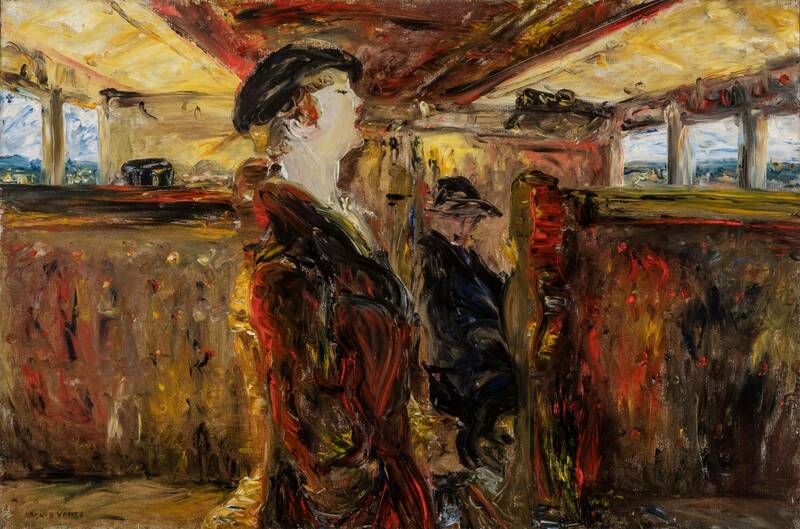
in a pub’s darkness
a woman sings
of a swallow’s wing
The rhyme here, untypical as it may be, draws attention to Carson’s careful sound placement in the best of his work. Note how the vowel in ‘sings/wing’ is foreshadowed in the initial ‘in’, while the plural ‘s’ that throws the rhyme slightly off kilter is part of a thread of similar sounds running through all three lines. And then there are the ‘w’ sounds running through.
I’m tempted to link Carson’s use of assonance to his positioning of his work in a distinctly Irish tradition. It may be fanciful to hear an echo of the Celtic Twilight in the book’s title (less so, perhaps, given the Jack Yeats poems), but the Irish literary link is most forceful, unsurprisingly perhaps, in a set of five haiku in the Irish language under the title ‘Séideann An Gaoth’ (The Wind Blows). One poem in particular has a very specific and resonant allusion to the Early Irish:
londubh buí
I measc na gcrann
séideann an gaothyellow blackbird
among the trees
the wind blows(my translation)
It’s impossible not to be reminded of the widely translated 9th century poem often referred to as ‘The Blackbird of Belfast Lough’ behind these lines, particularly given the broader Belfast connections in the book:
Int én bec
ro léic feit
do rinn guip
glanbuidi:
fo-ceird faíd
ós Loch Laíg,
lon do chraíb
charnbuidi.one small bird
whose note’s heard
sharply pointed
yellowbillwhose notes fly
on Loch Laig
blackbird’s branch
yellowfilled(again my version)
Along with, perhaps. a hint of the tale of ‘Buile Shuibhne’, the mad birdman of Irish legend. The poem also resonates with Carson’s English-language ‘nature’ haiku, quite closely in this example from ‘Island Haiku (Árainn Mhór)’:
sheets of rain
a robin shelters
inside a thorny bush
Belfast Twilight is a fine collection, full of quiet moments of delight.
I first encountered Tim Murphy’s work when we both had haiku included in Pat Boran’s Local Wonders anthology a few years back and just a few pages apart thanks to the wonders of alphabetical order. One of those haiku, also collected here, reads:
lockdown
do the birds wonder
where we are?
eight words that encapsulate what was a shared experience of Covid times, the sudden awareness of the natural within the urban as a reciprocal arrangement that so many of us shared.
These poems are filled with the streets of his adopted Spanish home, particularly Madrid, its cafés, bookshops, balconies and people, but the lines between the human world and the natural, on occasions the cosmic, are never impermeable:
planetary shift
checking the price
of a lottery ticket
or again
winter bee
a helicopter flies low
near the airbase
Haiku? Senryu? Does it matter?
Like Carson, Murphy also acknowledges his debt to the early masters of the form. Take for example this poem, which on one level is rooted in recent Spanish history and its lingering legacy:
visiting
civil war trenches
summer grass
But to the reader familiar with the Oku no Hosomichi, this poem cannot but bring to mind Bashō’s visit to Takadachi, once home of the warrior Minamoto no Yoshitune, but by the poet’s time long since reclaimed by the grass, and, remembering a still earlier poem, Tu Fu’s ‘A Spring View’, and wrote these lines:
Natsukusa ya
tsuwamono-domo ga
yume no ato.Only summer grass grows
Where ancient warriors
Used to dream!(Romanji transliteration and translation from Bashō’s Haiku by Toshiharu Oseko.)
And so a moment in time with its own political and historical cargo becomes part of the weave of tradition. As does, in a different way, this image of, I take it, street sellers, echoing Maya Angelou:
sudden downpour
the caged parakeets sing
louder
The caging also serves to complicate the relationship between the urban and natural worlds, a relationship also reflected in poems that are on the surface less conscious of the issues at stake:
yellow aspens…
the river water bites
into silence
Again, the balancing of sound is crucial to why and how these poems work. The sibilance is obvious, but it is that long /aɪ/ in ‘bite’ coming after four short stressed vowels that enacts the grip of the water before being echoed in the following ‘silence’, so that the two words are linked phonically as well as grammatically.
As with all good haiku, what’s left out is as important as what is said, or, to quote the poem that gives the book its title:
upward spiral
no one else ever knows
the whole story
These poems let us glimpse enough of the story to let us fill in the gaps for ourselves. Who could ask for more?
And now maybe its time for 21st century English language poets to accept the blurring of the haiku/senryu line in line with their Japanese counterparts of ninety years ago.